
How to vibe codeKnack
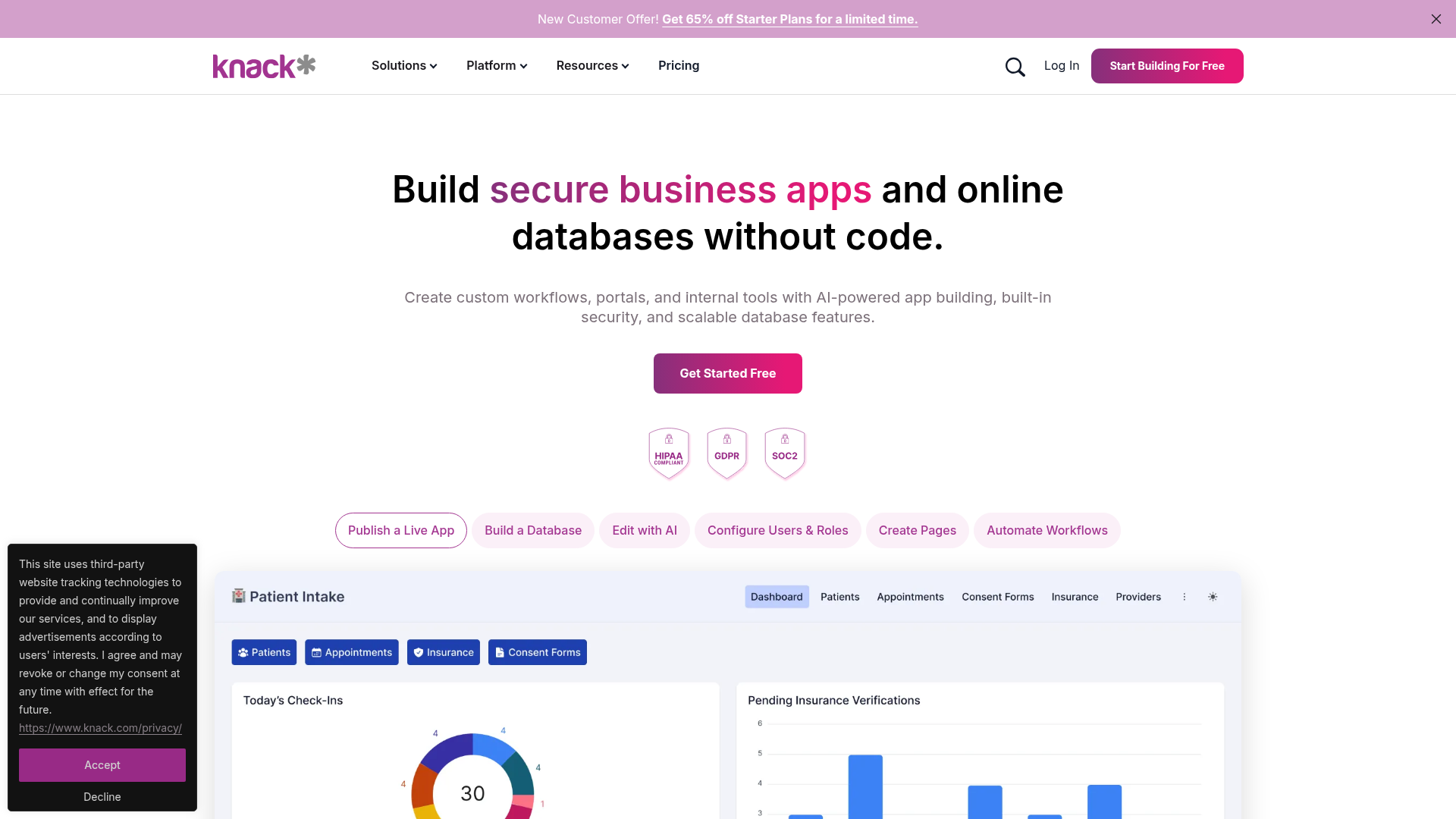
Build secure business apps and online databases without code.
knack.com ↗No-Code Database & App Builder
The verdict: can you vibe code Knack?
You can build a functional personal database builder subset, but replicating the dynamic runtime UI renderer and workflow engine requires serious engineering.
Knack bridges a relational database management system, a dynamic component rendering engine, and an automation builder into a unified web app. While an AI coding agent can scaffold the Next.js frontend, database wrappers, and basic CRUD tables in a few days, building a robust metadata-driven UI builder where arbitrary user-defined schemas instantly materialize into working calendars, kanban boards, and permissioned portals takes weeks of intricate state management and database abstraction work.
Estimated effort: 4-6 weeks of dedicated development
What you can't replicate
- Knack's 15-year enterprise compliance and security audit trail (HIPAA/SOC 2)
- Ecosystem of 500+ native third-party SaaS integrations
Founded
2010
Raised
$5.5M
Team
50-100
Cheapest paid tier
$19/mo
What Knack does
A cloud-hosted, no-code database and business application builder that enables users to structure relational data, design operational dashboards, and launch custom workflows.
Core features
- Dynamic visual schema designer for relational database tables and foreign keys
- AI-assisted natural language application and schema generator
- Modular drag-and-drop UI component renderer (grids, forms, calendars, charts)
- Granular role-based access control (RBAC) and row-level permissions
- Asynchronous workflow automation engine ('Knack Flows')
- Multi-tenant customer and internal user portal routing
The business
Pricing
- Starter$19/mo
- Pro$49/mo
- Corporate$250/mo
Funding
$5.5M from Precursor Ventures, Jeff Vinick, Emergence Capital, Felicis Ventures, Inovia Capital, Uncork Capital, Nick Hanauer, Resurgens Technology Partners
Pay vs build, cumulative
Break-even at month 1 — after that, every month is money kept.
The hard parts of vibe coding Knack
- Building a dynamic metadata schema engine that alters relational SQL tables or handles flexible JSON schemas at runtime without downtime
- Translating arbitrary database record schemas into interactive operational UI components dynamically
- Implementing deterministic row-level security and tenant isolation rules across complex relational queries
- Designing a visual workflow trigger and action graph execution runner
How to vibecode Knack
Prerequisites
Node.jsfree
Required runtime for modern full-stack TypeScript web applications.
GitHubfree
Source control and deployment pipeline integration.
AI coding tools
Recommended stack
| Frontend | Next.js |
|---|---|
| Backend | Next.js Server Actions |
| Database | Neon |
| Auth | better-auth |
| Payments | none |
| Other | Vercel AI SDK, Anthropic API, Resend |
Build guide
01Project Scaffolding & Database Schema Foundation
Initialize a Next.js full-stack application using TypeScript, Tailwind CSS, and Drizzle ORM connected to Neon PostgreSQL.
Scrape together a new Next.js project with Tailwind CSS, TypeScript, and Drizzle ORM configured for Neon PostgreSQL. Set up the foundational database tables for multi-tenant applications: `apps` (id, name, owner_id), `tables` (id, app_id, name, slug), `fields` (id, table_id, name, type, options), and dynamic record storage tables. Implement a base layout with sidebar navigation and clean styling.02Dynamic Schema & Table Builder Interface
Build an administrative interface allowing users to visually create custom database tables, add text/number/relation fields, and modify table schemas.
Create a table management dashboard where users can define custom database tables and add fields (text, number, date, connection/foreign key). Implement server actions that handle metadata changes and update the underlying database state. Add an interactive data grid view that dynamically renders records based on these custom field definitions with sorting and filtering capabilities.03AI-Powered App Generator
Integrate the Vercel AI SDK and Anthropic API to allow users to describe a business application in natural language, automatically generating tables and fields.
Implement an AI app builder drawer using the Vercel AI SDK and Anthropic API. Allow users to type a prompt describing an application (e.g., 'Build a pest control work order tracker'). The AI must output a structured JSON schema defining tables and fields, which is then automatically parsed and created in the database via server actions.04Visual Component Layout Engine
Build a page layout editor where users can place views (grids, forms, details, calendars) onto pages connected to their custom tables.
Build a visual page builder interface where application creators can add operational views (Forms for input, Grids for tables, Details for single records) to specific pages. Implement dynamic component renderers that fetch and display record data according to the configured view layout settings.05User Roles, Permissions & Live App Portal
Implement authentication via better-auth, role management, and row-level security constraints for the published Live Apps.
Integrate better-auth for user management with support for custom roles (Admin, Staff, Customer). Build a permissions matrix editor that restricts view and record visibility based on user roles and account relationships. Ensure the published 'Live App' client portal enforces these visibility rules dynamically on server queries.06Workflow Automation Engine ('Knack Flows')
Create an event-driven workflow automation engine to trigger actions when records are created, updated, or deleted.
Build an automation workflow builder ('Flows') that lets users define triggers (e.g., Record Created on 'Orders') and actions (e.g., Send Email via Resend, or update a connected record field). Implement a background execution loop or serverless event handler to process these rules reliably.
Cost vs paying for Knack
What will you build it with?
Starting total with Claude Code$0 one-time
Starting costs (one-time)
- AI Coding Assistant Subscriptions$20
Total~$20 one-time
Ongoing costs (monthly)
- Vercel Hosting & Neon Database$0-10/mo
- Anthropic API Credits for AI Builder~$5/mo
Total~$15/mo
Paying for Knack
$49/mo (Pro Tier)
Your time to build
40-60 hours
AI tool credits
$20 (Claude Code / Cursor Pro)
Break-even
Never (built for learning and personal workflow automation)
Own Knack? Wear the score
Put this badge on your site or README — it links back to this report.
<a href="https://vibeityourself.com/app/knack"><img src="https://vibeityourself.com/badge/knack" alt="Knack vibe-codeability score" /></a>[](https://vibeityourself.com/app/knack)Vibe code Knack: FAQ
- Can you vibe code Knack yourself?
- Serious undertaking — 38/100 vibecodeable. You can build a functional personal database builder subset, but replicating the dynamic runtime UI renderer and workflow engine requires serious engineering.
- How long does it take to vibe code Knack?
- 4-6 weeks of dedicated development — roughly 40-60 hours of hands-on time with an AI coding agent.
- How do you build your own Knack?
- Scoped to personal use: Next.js on the front, Next.js Server Actions behind it, Neon for data. Follow the 6-step build guide on this page — each step has a paste-ready prompt for an AI coding agent.
- How do you code your own Knack without being an expert?
- Use an AI coding tool (Claude Code or Cursor) and work in small steps: scaffold, data model, core screens, then deploy. Realistic effort: 4-6 weeks of dedicated development. The prompts on this page are written so the AI does the heavy lifting.
- How much does it cost to vibe code Knack instead of paying?
- About ~$20 one-time to start and ~$15/mo to run, versus $49/mo (Pro Tier) for Knack. Break-even: Never (built for learning and personal workflow automation).
- What stack should you use to vibe code Knack?
- Next.js; Next.js Server Actions; Neon; plus Vercel AI SDK, Anthropic API, Resend.
Methodology
This report was generated by VibeItYourself's standard pipeline: we scrape knack.com (content, branding, screenshot), deep-research the company with AI + web search (pricing, funding, team, engineering complexity), then score rebuild feasibility 0–100 against the same rubric used for every app — scoped to a personal-use clone, not a competing business. How scoring works. Verdicts are honest by design: what you can't replicate is listed above.
Last verified: