
How to vibe codeGamma
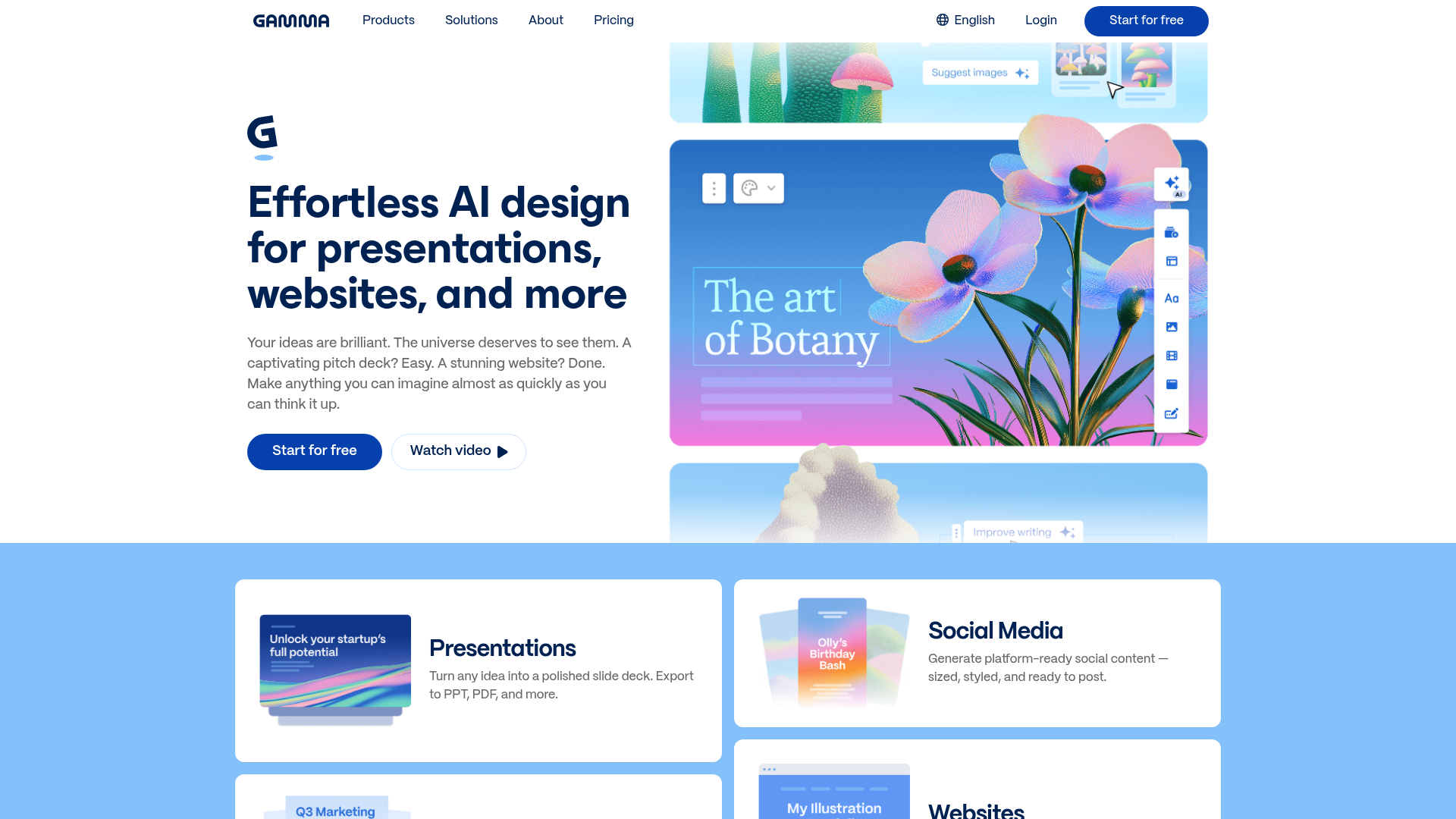
Effortless AI design for presentations, websites, and more
gamma.app ↗AI Design & Content Creation
The verdict: can you vibe code Gamma?
You can build a functional personal prompt-to-card presentation generator, but replicating Gamma's polished layout constraint engine and multi-model orchestration will take weeks of rigorous iteration.
Building a basic version where an LLM returns JSON representing structured slides and renders them using Tailwind CSS is entirely achievable with modern AI coding assistants. However, you will hit friction when trying to get LLMs to consistently output structurally valid card layouts that look professionally designed instead of generic markdown blocks. Managing async generation queues for text and image models, and building reliable PDF/PPTX exports, will consume the bulk of your development time.
Estimated effort: 3-4 weeks of focused development
What you can't replicate
- The massive proprietary template library and layout constraint engine tuned over millions of generations
- Enterprise agreements and direct credit allocations across 20+ frontier foundation models
- The $100M ARR distribution engine and brand loyalty
Founded
2021
Raised
$90M
Team
~50
Cheapest paid tier
$0
What Gamma does
An AI-powered content creation and design platform that turns prompts, outlines, or documents into scrollable, responsive visual cards for presentations, websites, and documents.
Core features
- Prompt-to-deck or website pipeline generating structured content trees
- Flexible card-based block layout engine with responsive design
- Multi-model orchestration layer connecting text models (Claude/GPT) and image generation (Flux/Ideogram)
- Theme and brand styling engine for custom CSS variables and typography
- Interactive block components (accordions, galleries, embeds, cards)
- Export rendering engine for PDF and PowerPoint (PPTX) downloads
The business
Pricing
- Free$0
- Plus$9/mo
- Pro$18/mo
- Ultra$90/mo
Funding
$90M from Andreessen Horowitz (a16z), Accel, Afore Capital, Uncork Capital, South Park Commons, Script Capital
Pay vs build, cumulative
Break-even at month 3 — after that, every month is money kept.
The hard parts of vibe coding Gamma
- Translating raw LLM text output into structured, visually appealing hierarchical web card layouts without breaking responsiveness
- Coordinating multi-model pipelines where text generation feeds into sequential image generation and layout placement prompts
- Building a performant visual editor that supports smooth block reordering, inline formatting, and dynamic theme switching
- Handling complex export formatting for PPTX and PDF documents from custom web DOM structures
How to vibecode Gamma
Prerequisites
Node.jsfree
Required for running the Next.js development environment.
GitHubfree
For version control and deploying your project.
Anthropic API KeyPay-as-you-go
Powers structured text generation for presentations and documents.
fal.ai API KeyPay-as-you-go
Provides fast image generation via Flux for illustrations and card visuals.
AI coding tools
Recommended stack
| Frontend | Next.js with Tailwind CSS and Framer Motion |
|---|---|
| Backend | Next.js Server Actions and API Routes |
| Database | Turso (SQLite at the edge) |
| Auth | better-auth |
| Payments | None (personal clone) |
| Other | Anthropic API, fal.ai API |
Hosting & infrastructure
| Cloudflare | Hosting the Next.js frontend and edge API routes | $0-5/mo |
Build guide
01Scaffold Project & Database Schema
Initialize a Next.js application with Tailwind CSS, configure better-auth with Turso, and set up the database tables for projects, cards, and themes.
Create a new Next.js project with Tailwind CSS, TypeScript, and Lucide React icons. Set up better-auth with SQLite via Turso using @libsql/client. Create database schema definitions for 'projects' (id, userId, title, theme, createdAt) and 'cards' (id, projectId, orderIndex, layoutType, contentJson). Ensure proper foreign key relationships and write initial migration scripts.02Build AI Orchestration Pipeline
Implement a server-side generation route that calls the Anthropic API with structured output prompting to convert a user prompt into a JSON array of presentation cards.
Implement an API route in Next.js that accepts a user prompt and presentation style. Write a robust system prompt for Anthropic Claude that instructs the model to output a strict JSON array representing presentation cards. Each card must include a layout type (e.g., 'hero', 'split', 'grid', 'bullets'), heading, body copy, and image placeholder prompts. Validate the response using Zod before returning it to the client.03Build Image Generation Integration
Integrate fal.ai to automatically generate background or contextual images for cards that require visual elements.
Create a utility module that calls the fal.ai Flux Schnell endpoint to generate images based on prompts extracted from card JSON. Handle API errors gracefully with fallback illustrations. Add a server action that updates a card's background or illustration URL in the Turso database once generation completes.04Develop Card Renderer & Layout Engine
Build responsive React components that dynamically render different card layouts (split columns, bullet cards, image grids) with customizable themes.
Build a responsive presentation viewer component in React that renders an array of card objects. Create distinct layout components for 'hero', 'split-content', 'feature-grid', and 'quote-block'. Implement theme support that dynamically injects CSS variables for background colors, font families, and accent borders based on the project's selected theme.05Implement Visual Editor & Reordering
Add interactive editing capabilities allowing users to modify card text inline, reorder cards, and regenerate individual sections with AI.
Build an interactive editor view for projects where users can click to edit card text inline, drag cards to reorder them using dnd-kit or similar primitives, and trigger targeted AI regeneration on a single card using a floating action toolbar. Save changes to Turso via debounced server actions.06Add Export and Sharing Functionality
Implement print styles and PDF export functionality so users can download their presentations as clean documents.
Implement a print-friendly CSS stylesheet and export action using html2pdf.js or browser print APIs so users can export their slide decks or web pages as clean PDF documents. Add a public sharing view with a unique URL slug for viewing published projects without editing access.
Cost vs paying for Gamma
What will you build it with?
Starting total with Claude Code$0 one-time
Starting costs (one-time)
- AI Coding Assistant Subscription$20
- API Credits (Anthropic & fal.ai)$10
Total~$30 one-time
Ongoing costs (monthly)
- Cloudflare & Turso free tiers$0
- API usage for personal generations~$5/mo
Total~$5/mo
Paying for Gamma
$18/mo (Pro tier)
Your time to build
30-40 hours
AI tool credits
$20 (Cursor/Claude Pro) + API usage
Break-even
2 months of Pro subscription
Own Gamma? Wear the score
Put this badge on your site or README — it links back to this report.
<a href="https://vibeityourself.com/app/gamma"><img src="https://vibeityourself.com/badge/gamma" alt="Gamma vibe-codeability score" /></a>[](https://vibeityourself.com/app/gamma)Vibe code Gamma: FAQ
- Can you vibe code Gamma yourself?
- Solid side project — 62/100 vibecodeable. You can build a functional personal prompt-to-card presentation generator, but replicating Gamma's polished layout constraint engine and multi-model orchestration will take weeks of rigorous iteration.
- How long does it take to vibe code Gamma?
- 3-4 weeks of focused development — roughly 30-40 hours of hands-on time with an AI coding agent.
- How do you build your own Gamma?
- Scoped to personal use: Next.js with Tailwind CSS and Framer Motion on the front, Next.js Server Actions and API Routes behind it, Turso (SQLite at the edge) for data. Follow the 6-step build guide on this page — each step has a paste-ready prompt for an AI coding agent.
- How do you code your own Gamma without being an expert?
- Use an AI coding tool (Claude Code or Cursor) and work in small steps: scaffold, data model, core screens, then deploy. Realistic effort: 3-4 weeks of focused development. The prompts on this page are written so the AI does the heavy lifting.
- How much does it cost to vibe code Gamma instead of paying?
- About ~$30 one-time to start and ~$5/mo to run, versus $18/mo (Pro tier) for Gamma. Break-even: 2 months of Pro subscription.
- What stack should you use to vibe code Gamma?
- Next.js with Tailwind CSS and Framer Motion; Next.js Server Actions and API Routes; Turso (SQLite at the edge); plus Anthropic API, fal.ai API.
Methodology
This report was generated by VibeItYourself's standard pipeline: we scrape gamma.app (content, branding, screenshot), deep-research the company with AI + web search (pricing, funding, team, engineering complexity), then score rebuild feasibility 0–100 against the same rubric used for every app — scoped to a personal-use clone, not a competing business. How scoring works. Verdicts are honest by design: what you can't replicate is listed above.
Last verified: