How to vibe codeAlchemer
Enterprise feedback management and Voice of the Customer platform
alchemer.com ↗Voice of the Customer / Survey SaaS
The verdict: can you vibe code Alchemer?
Build a simple survey-collection subset rather than trying to clone Alchemer; the true enterprise moat lies in 400+ robust integrations and strict compliance certifications.
While an AI coding agent can easily scaffold a basic drag-and-drop survey form runner with Neon and Next.js, replicating Alchemer's four pillars (Compass, Collect, Connect, Clarity) is a monumental engineering feat. Building and maintaining over 400 bi-directional enterprise connectors against third-party API changes, coupled with stringent SOC 2 Type II and GDPR data governance requirements, creates an immense maintenance trap for a solo developer. For actual enterprise needs, buying Alchemer is vastly more rational unless you are intentionally scoping this down to a basic personal questionnaire tool.
Estimated effort: 3 to 5 months of full-time work for a robust subset
What you can't replicate
- The 400+ native enterprise integration ecosystem
- SOC 2 Type II audit history and strict enterprise governance frameworks
- Network effect of 3.4+ billion historical survey responses across 11,000 corporate clients
Founded
2006
Raised
—
Team
230-300
Cheapest paid tier
$55/mo
What Alchemer does
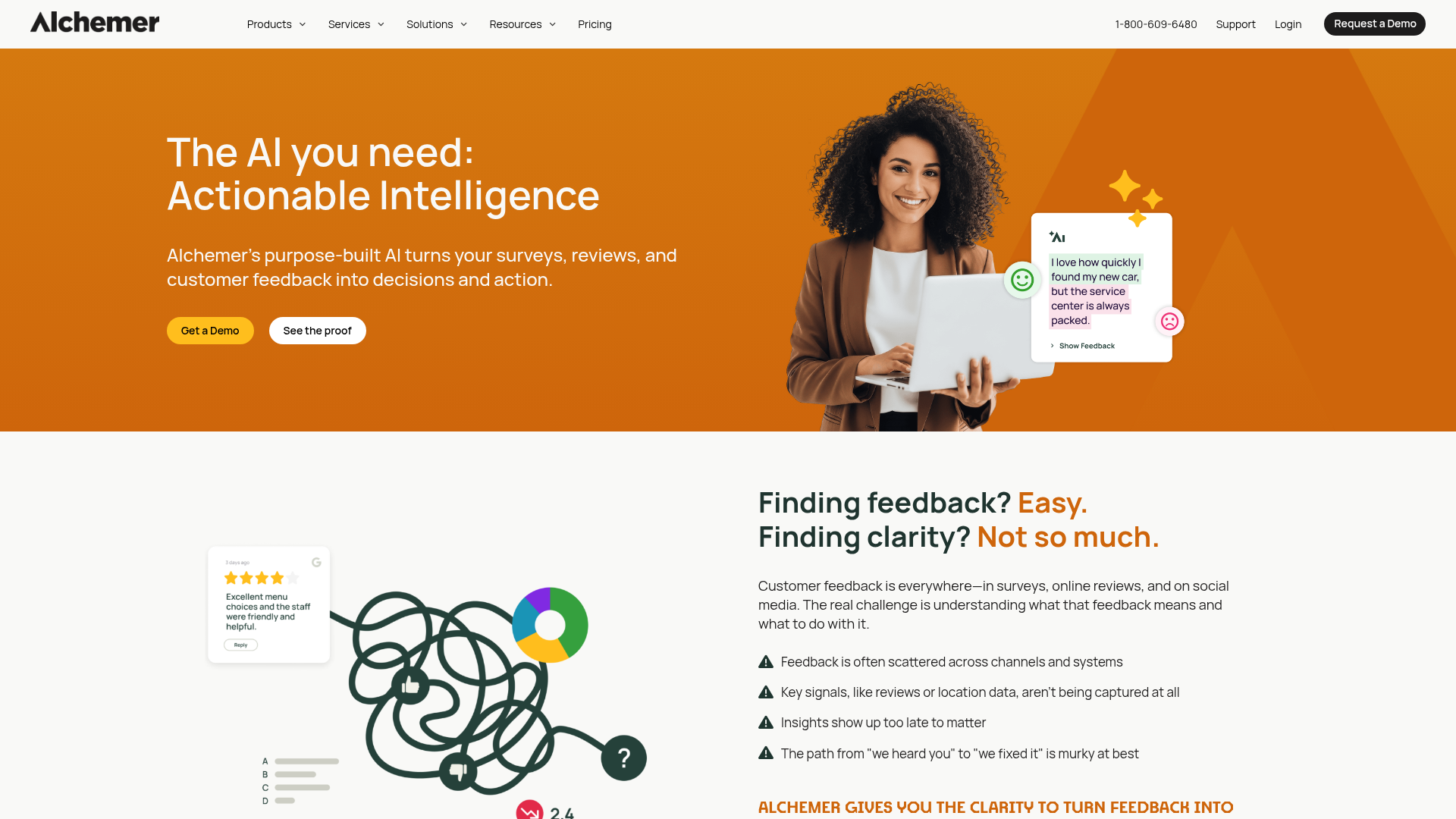
Alchemer is an enterprise feedback management and Voice of the Customer (VoC) platform providing omnichannel survey collection, local SEO listings management, deep integrations, and AI-driven sentiment analysis.
Core features
- Multi-channel survey builder with advanced skip logic and piping
- Digital experience and in-app feedback widgets
- Omnichannel review aggregation and local listings management
- AI sentiment analysis and text analytics engine
- Pre-built workflow integrations and automation builder
- Executive reporting dashboards with data export tools
The business
Pricing
- Collaborator Plan$55/mo
- Professional Tier$165/mo
- Enterprise CustomCustom
Funding
Unknown / bootstrapped
Pay vs build, cumulative
Break-even at month 1 — after that, every month is money kept.
The hard parts of vibe coding Alchemer
- Maintaining 400+ bi-directional, resilient enterprise third-party API connectors against breaking changes
- Executing complex, client-side/server-side survey branching logic and piping without latency at scale
- Building robust SOC 2 Type II compliance, GDPR controls, and granular role-based access control (RBAC)
- Real-time ingestion pipelines across high-volume app stores, review platforms, and social feeds
How to vibecode Alchemer
Prerequisites
Node.jsFree
Required runtime for modern full-stack TypeScript web development.
GitHubFree
Source control and deployment pipeline integration.
Anthropic API KeyPay-as-you-go
Needed for powering AI sentiment analysis and text review summaries.
AI coding tools
Recommended stack
| Frontend | Next.js with Tailwind CSS |
|---|---|
| Backend | Next.js API Routes / Server Actions |
| Database | Neon (Serverless Postgres) |
| Auth | better-auth |
| Payments | Stripe |
| Other | Anthropic API for sentiment analysis, Resend for email notifications, PostHog for analytics |
Build guide
01Project Scaffolding & Database Schema
Initialize a Next.js application with TypeScript, Tailwind CSS, and configure Neon Postgres with Prisma or Drizzle ORM to handle users, surveys, questions, logic rules, and responses.
Create a new Next.js project using App Router and configure Tailwind CSS. Set up Drizzle ORM to connect to a Neon Postgres database. Define the database schema for users, surveys, questions (supporting types like multiple choice, text, rating scales), logic branching rules, and response submissions with JSONB metadata fields. Ensure proper foreign key constraints and indexes for fast response querying.02Authentication & Workspace Management
Implement authentication using better-auth to support email/password sign-in and multi-user workspace organizations.
Integrate better-auth into the Next.js application to support secure user registration, session management, and organization workspaces. Add database migrations for auth tables and protect dashboard routes so users can only access their own survey projects.03Interactive Survey Builder & Form Engine
Build a drag-and-drop or modular survey creation interface allowing users to add questions, configure settings, and preview surveys in real-time.
Build a survey builder UI in Next.js with a sidebar for adding different question types (text, rating scale, dropdown, matrix). Implement state management using Zustand or React hook form so users can reorder questions, edit titles, and save survey configurations to the database. Create a dedicated public survey runner route (/s/[surveyId]) that dynamically renders the survey questions based on database configuration.04Survey Logic & Branching Engine
Implement conditional display rules and skip logic so survey flows adapt based on respondent answers.
Implement a survey logic engine supporting conditional skip rules (e.g., if question 1 equals 'Option A', skip to question 4). Update the survey runner component to evaluate logic rules dynamically on the client side as respondents progress, managing page navigation and state seamlessly.05Response Ingestion & Analytics Dashboard
Build backend endpoints to record survey submissions and create an analytics view displaying response counts, completion rates, and visualization charts.
Create a secure API endpoint for submitting survey responses that validates incoming payloads against survey question schemas. Build a dashboard analytics page featuring summary metrics, response timeline charts using Recharts, and a detailed data grid view for viewing individual submission results.06AI Sentiment Analysis Integration
Integrate the Anthropic API to analyze open-ended text feedback responses, generating automated sentiment scores and key theme summaries.
Incorporate the Anthropic API to parse open-ended text responses collected from surveys. Create a background server action or API route that processes text fields, extracts sentiment (positive, neutral, negative), summarizes key themes, and persists these insights to the database for display on the analytics dashboard.
Cost vs paying for Alchemer
What will you build it with?
Starting total with Claude Code$0 one-time
Starting costs (one-time)
- Custom Domain$12
- AI Coding Credits$60
Total~$72 one-time
Ongoing costs (monthly)
- Vercel Hobby/Pro Hosting$0 - $20/mo
- Anthropic API Usage$5 - $15/mo
Total~$5 - $35/mo
Paying for Alchemer
$55 - $275+/mo per user
Your time to build
250 hours
AI tool credits
$60
Break-even
N/A (Built for learning/subset use)
Own Alchemer? Wear the score
Put this badge on your site or README — it links back to this report.
<a href="https://vibeityourself.com/app/alchemer"><img src="https://vibeityourself.com/badge/alchemer" alt="Alchemer vibe-codeability score" /></a>[](https://vibeityourself.com/app/alchemer)Vibe code Alchemer: FAQ
- Can you vibe code Alchemer yourself?
- Serious undertaking — 38/100 vibecodeable. Build a simple survey-collection subset rather than trying to clone Alchemer; the true enterprise moat lies in 400+ robust integrations and strict compliance certifications.
- How long does it take to vibe code Alchemer?
- 3 to 5 months of full-time work for a robust subset — roughly 250 hours of hands-on time with an AI coding agent.
- How do you build your own Alchemer?
- Scoped to personal use: Next.js with Tailwind CSS on the front, Next.js API Routes / Server Actions behind it, Neon (Serverless Postgres) for data. Follow the 6-step build guide on this page — each step has a paste-ready prompt for an AI coding agent.
- How do you code your own Alchemer without being an expert?
- Use an AI coding tool (Claude Code or Cursor) and work in small steps: scaffold, data model, core screens, then deploy. Realistic effort: 3 to 5 months of full-time work for a robust subset. The prompts on this page are written so the AI does the heavy lifting.
- How much does it cost to vibe code Alchemer instead of paying?
- About ~$72 one-time to start and ~$5 - $35/mo to run, versus $55 - $275+/mo per user for Alchemer. Break-even: N/A (Built for learning/subset use).
- What stack should you use to vibe code Alchemer?
- Next.js with Tailwind CSS; Next.js API Routes / Server Actions; Neon (Serverless Postgres); plus Anthropic API for sentiment analysis, Resend for email notifications, PostHog for analytics.
Methodology
This report was generated by VibeItYourself's standard pipeline: we scrape alchemer.com (content, branding, screenshot), deep-research the company with AI + web search (pricing, funding, team, engineering complexity), then score rebuild feasibility 0–100 against the same rubric used for every app — scoped to a personal-use clone, not a competing business. How scoring works. Verdicts are honest by design: what you can't replicate is listed above.
Last verified: